

How to Increase Event Attendance by 3X in 90 Days
The Ultimate Event Marketing Guide to Attract More Attendees, Generate Better Leads & Maximize Event ROI
Using the right strategy at the right time is more important for successful event marketing than having the largest budget. No matter if you want to exhibit at a trade show, corporate event, conference, webinar, product launch, or exhibition, you need a strategy.
You will learn the precise framework of professional marketers in this guide. This guide will help you raise awareness, draw in the right audience, boost registrations, convert attendees into devoted patrons, and more.
What You’ll Learn
- Build a complete event marketing strategy
- Promote events across multiple marketing channels
- Increase event registrations and attendance
- Generate more qualified leads
- Improve attendee engagement
- Measure event ROI like a professional
- Avoid the most common event marketing mistakes
Estimated Reading Time: 35–45 Minutes
Why This Guide Is Different
Most articles about event marketing only offer a few promotional ideas. But this is a much more exhaustive trade show marketing guide for exhibitors. You’ll learn a comprehensive and repeatable framework instead of learning specific tactics. This framework will include planning, promotion, attendee engagement, post-event follow-up and much more. Instead of speculating about what works, you will understand how each marketing activity contributes to a successful event campaign.
Chapter 1: What Is Event Marketing?
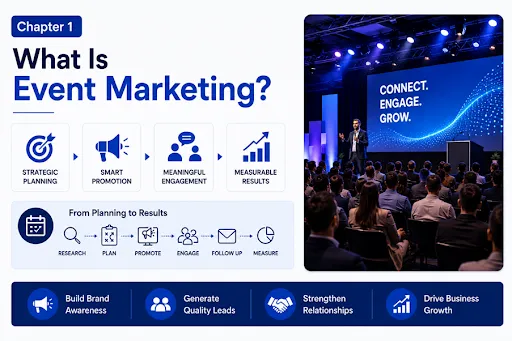
Event marketing is the process of organizing, promoting, managing, and evaluating an event to achieve specific business objectives. Those goals could be to increase brand awareness or generate qualified leads. It may be a new product launch. You may want to improve customer relations, boost sales, and more. It may be anything related to your business growth.
Event marketing is an alternative to traditional advertising. It’s an authentic way for brands to connect with their audience. The best event marketing starts well before the event. This includes audience research, campaign strategy, digital promotion, content creation, registration optimization, on-site engagement, post-event follow-up and more.
When all these pieces come together, an event is much more than simply a get-together; it becomes a powerful marketing tool that produces measurable business results.
Chapter 2: Why Event Marketing Matters
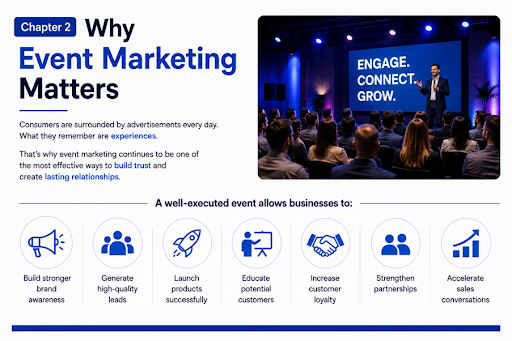
Consumers are surrounded by advertisements. They remember things. As a result, event marketing continues to be one of the most effective methods for building trust and long-lasting business relationships. Trade shows encourage in-the-moment conversations. Exhibitions provide chances for personalized experiences, networking, demonstrations, and more. These business events influence purchase decisions. A well-run event can help companies:
- Increase brand recognition
- Produce superior leads
- Launch goods with success
- Inform prospective clients
- Boost client loyalty
- Boost collaborations
- Boost sales dialog
Chapter 3: Types of Event Marketing
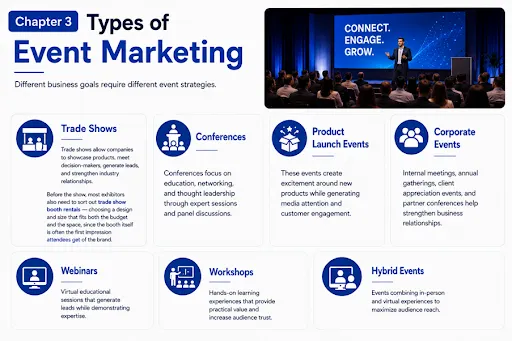
Different event strategies are needed for different business objectives.
Trade Exhibitions
Trade exhibitions give businesses the chance to present their goods. Here you can network with decision-makers. You can create leads. Also, you can fortify ties within the industry. Before the show, run through a trade show exhibitor checklist that covers your booth, staff, giveaways, and lead capture tools.
Since the booth itself is frequently the first impression attendees get of the brand, most exhibitors also need to arrange trade show exhibit rentals prior to the show, selecting a design and size that fits both the budget and the space.
Conferences
Through expert sessions and panel discussions, conferences emphasize networking, education, and thought leadership.
Events for Product Launches
In addition to attracting media attention and consumer interaction, these events generate excitement about new products.
Business Occasions
Business relationships are strengthened through partner conferences, client appreciation events, annual get-togethers, and internal meetings.
Webinars
Virtual educational sessions that generate leads while demonstrating expertise.
Workshops
Hands-on learning experiences that provide practical value and increase audience trust.
Hybrid Events
Events combining in-person and virtual experiences to maximize audience reach.
Chapter 4: Why Most Events Fail
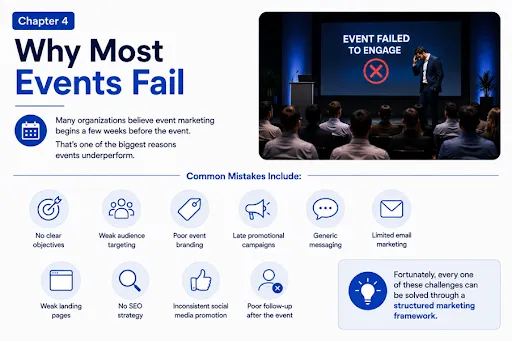
Many organizations believe event marketing begins a few weeks before the event. That’s one of the biggest reasons events underperform.
Common mistakes include:
- No clear objectives
- Weak audience targeting
- Poor event branding
- Late promotional campaigns
- Generic messaging
- Limited email marketing
- Weak landing pages
- No SEO strategy
- Inconsistent social media promotion
- Poor follow-up after the event
Fortunately, every one of these challenges can be solved through a structured marketing framework.
Chapter 5: The Event Growth Blueprint™
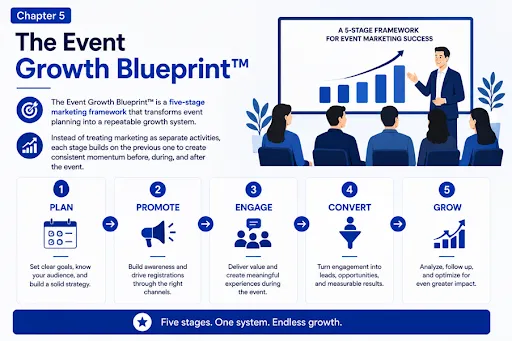
The Event Growth Blueprint™ is a five-stage marketing framework. This framework can transform event planning into a repeatable growth system.
Instead of treating marketing as separate activities, each stage builds on the previous one to create consistent momentum before, during, and after the event.
Phase 1 – PLAN
Every successful event starts with a clear strategy. You need to define your objectives, audience, budget, timeline, marketing channels, team responsibilities, etc., before launching any promotional campaign. Plus, you must be clear about the key performance indicators as well. If you don’t have a plan, your large marketing budgets will often fail to deliver meaningful results.
Phase 2 – ATTRACT
Once you have your strategy down, your next goal should be your brand’s visibility. You have to pull in your potential clients. Your goal is to make sure your audience does not ignore you. Here are some channels you can use to promote your event:
- Search Engine Optimization (SEO)
- Content Marketing
- Email Campaigns
- Social Media Marketing
- Paid Advertising
- PR & Media Outreach
- Influencer Partnerships
- Industry Communities
Phase 3 – CONVERT
You should remember that booth traffic alone doesn’t make your exhibiting successful. Small improvements in conversion rate can significantly increase registrations without increasing advertising spend. Focus on:
- High-converting landing pages
- Strong headlines
- Benefit-driven copy
- Clear CTAs
- Social proof
- Testimonials
- Simple registration forms
- Limited-time offers
Phase 4 – ENGAGE
The attendee experience determines how your brand is remembered. An engaged attendee is far more likely to become a loyal customer and brand advocate. To make sure that happens, take care of the following:
- Live demonstrations
- Interactive booths
- Networking opportunities
- Q&A sessions
- Gamification
- Mobile event apps
- Live social media coverage
- Personalized attendee experiences
Phase 5 – GROW
The event may end, but your marketing shouldn’t. This final phase transforms one successful event into long-term business growth. Continue building relationships by:
- Sending thank-you emails
- Sharing event highlights
- Publishing recap articles
- Nurturing leads
- Requesting feedback
- Measuring campaign performance
- Optimizing future events
Key Takeaways
By this point, you should understand what event marketing is, why it matters, the different types of events, why many events fail, and how the Event Growth Blueprint™ creates a repeatable system for success.
In the next section, we’ll move from strategy to execution, with practical and step-by-step tactics for every stage of your event marketing campaign.
Part 2A: Planning Your Event Like a Pro
A successful event starts months before with careful planning. The best marketing campaigns are backed by a solid strategy. You must have a clear goal and a solid grasp of the audience. In this chapter, you’ll lay the groundwork for an event that attracts the right people and produces measurable business results.
Chapter 6: Planning Your Event
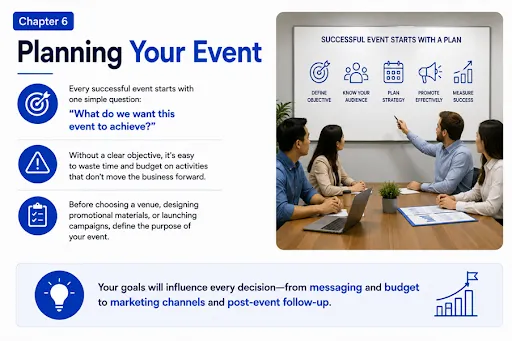
Every successful event starts with one simple question: “What do we want this event to achieve?” You should ask it of yourself, because without a clear objective, it’s easy to waste time and budget on activities that don’t move the business forward. That’s why you need to set the purpose of your event before you decide on a venue, design fliers, or run a campaign. Your goals will dictate everything: messaging, budget, marketing channels, post-event follow-up, and more.
The Event Planning Blueprint™
You need to follow these six planning stages before launching your marketing campaign.
Step 1 – Define Your Event Objective
Start by identifying the primary purpose of your event. Choose one primary objective and two or three supporting objectives to keep your strategy focused. Typical objectives include:
- Launching a new product or service
- Generating qualified sales leads
- Building brand awareness
- Educating customers
- Networking with industry professionals
- Strengthening customer relationships
- Driving direct sales
Step 2 – Create Your Event Timeline
Planning early gives you enough time to build awareness and generate registrations. If you are exhibiting, start by reviewing the trade show calendar for your industry so you can shortlist the right shows and lock your dates well in advance. The recommended timeline:
90 Days Before: finalize event goals, secure the venue or virtual platform, create the event landing page, publish the first announcement, begin SEO optimization.
60 Days Before: launch email campaigns, start paid advertising, publish blog content, announce speakers and sponsors, share promotional videos.
30 Days Before: increase social media activity, send reminder emails, run retargeting campaigns, schedule interviews and live sessions.
7 Days Before: share event logistics, confirm registrations, publish countdown posts, test all event technology.
Step 3 – Build Your Marketing Team
If you are exhibiting, you need to assign clear responsibilities to your team. When everyone understands their responsibilities, campaigns run much more smoothly and it avoids confusion during the campaign. Typical roles include:
- Event Manager
- Marketing Manager
- Social Media Coordinator
- Content Writer
- Graphic Designer
- Paid Advertising Specialist
- Email Marketing Manager
- Sales Team
- Customer Support
Step 4 – Set Your Budget
A well-planned budget prevents overspending and helps you concentrate on high-impact marketing activities. Track your expenses during the campaign to stay on budget. Common budget categories include:
- Venue
- Booth or exhibition space (including trade show display rentals)
- Branding materials
- Digital advertising
- Email marketing software
- Photography and videography
- Printing
- Promotional merchandise
- Staff travel
- Technology
- Contingency fund
Step 5 – Define Success Metrics
Marketing is just guesswork without measurement. Track key performance indicators and review these metrics regularly to optimize future campaigns:
- Event registrations
- Attendance rate
- Cost per registration
- Website traffic
- Landing page conversion rate
- Email open and click rates
- Social media engagement
- Qualified leads
- Sales opportunities
- Return on investment (ROI)
Chapter 7: Set SMART Event Goals
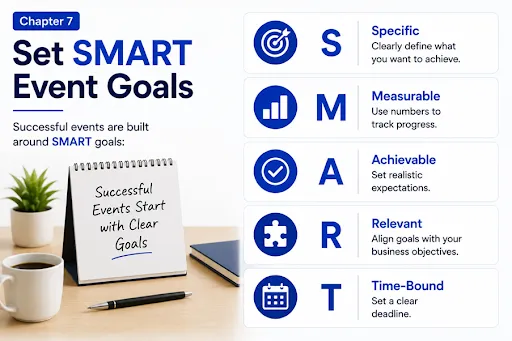
Successful events are built around SMART goals:
- Specific – Clearly define what you want to achieve.
- Measurable – Use numbers to track progress.
- Achievable – Set realistic expectations.
- Relevant – Align goals with your business objectives.
- Time-Bound – Set a clear deadline.
Example SMART Goals:
- Increase event registrations by 30% before registration closes.
- Generate 250 qualified leads during the event.
- Achieve a 20% landing page conversion rate.
- Increase email open rates to 35%.
- Schedule 50 sales meetings during the event.
SMART goals provide a clear direction and make it easier to measure success.
Chapter 8: Know Your Audience
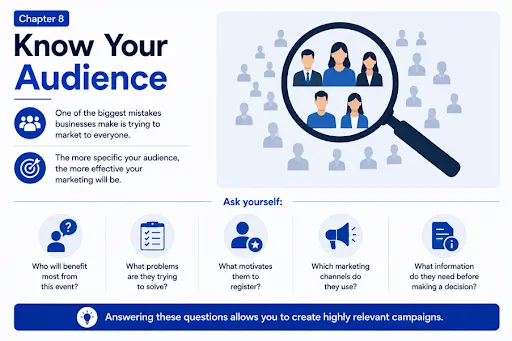
One of the biggest mistakes a business can make is trying to market to everyone. That’s why you need to get more specific about your audience, so you can do more targeted marketing. Ask yourself:
- Who will benefit most from this event?
- What problems are they trying to solve?
- What motivates them to register?
- Which marketing channels do they use?
- What information do they need before making a decision?
Build Detailed Buyer Personas
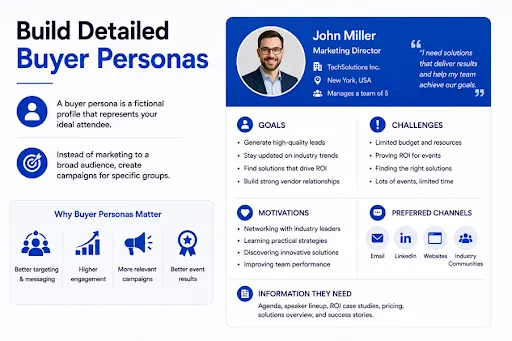
A buyer persona is a fictional profile that represents your ideal attendee. Instead of marketing to a broad audience, create campaigns for specific groups.
Persona Example
Name: Sarah
Job Title: Marketing Manager
Industry: Technology
Goals:
- Discover new marketing strategies
- Build professional connections
- Learn from industry experts
Challenges:
- Limited marketing budget
- Difficulty generating qualified leads
- Need to demonstrate ROI
Preferred Channels:
- Email newsletters
- Google Search
- Industry blogs
- Professional communities
Creating personas helps you write messages that resonate with the right audience.
Audience Segmentation
Not every attendee has the same interests. Segment your audience based on:
- Industry
- Job role
- Company size
- Geographic location
- Previous event attendance
- Purchase intent
- Customer lifecycle stage
Personalized campaigns consistently outperform generic messaging.
Chapter 9: Build a Memorable Event Brand
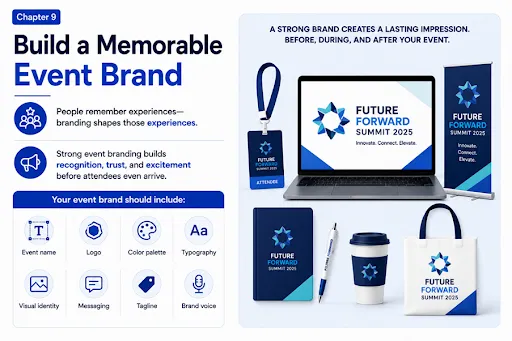
People remember experiences, and branding is what creates those experiences. Powerful event branding creates awareness, trust, and anticipation before guests arrive. Keep your branding consistent across all marketing channels, paying attention to:
- Event name
- Logo
- Color palette
- Typography
- Visual identity
- Messaging
- Tagline
- Brand voice
Create a Unique Value Proposition
Your event needs a compelling reason for people to attend. Instead of saying “Join our marketing conference,” say “Discover practical event marketing strategies you can implement immediately to generate more registrations, improve attendee engagement, and maximize ROI.” Focus on outcomes, not features.
Chapter 10: Create a High-Converting Event Landing Page
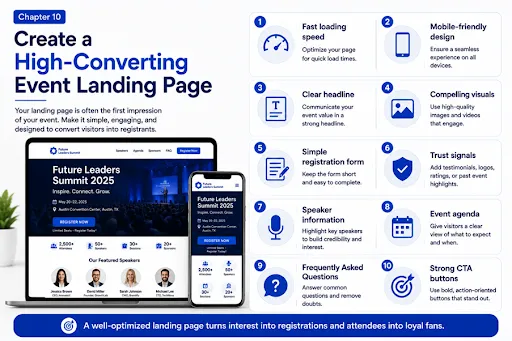
If you have a website for your business, you should already be aware of the landing page and its importance. You have to create such a landing page for your event too – it’s often the first impression potential attendees have of your event. Every element should encourage visitors to register.
Essential Elements
Compelling Headline – clearly communicate the primary benefit.
Supporting Subheadline – explain who the event is for and what attendees will gain.
Hero Image or Video – use high-quality visuals that reflect the event experience.
Event Details – include date, time, location, format, agenda, and speakers.
Key Benefits – explain what attendees will learn, experience, or achieve.
Social Proof – add testimonials, previous event highlights, sponsor logos, or attendee feedback to build credibility.
Registration Form – keep it simple. Only request essential information to reduce friction.
Strong Call-to-Action – examples: Register Today, Reserve Your Seat, Book Your Pass, Join the Event, Get Your Ticket. Use clear, action-oriented language throughout the page.
Landing Page Optimization Checklist
- Fast loading speed
- Mobile-friendly design
- Clear headline
- Compelling visuals
- Simple registration form
- Trust signals
- Speaker information
- Event agenda
- Frequently Asked Questions
- Strong CTA buttons
Key Takeaways
Before promoting your event, make sure you have these foundational elements in place to make every marketing campaign more effective:
- Defined clear business objectives
- Set measurable SMART goals
- Built detailed buyer personas
- Segmented your audience
- Created consistent event branding
- Developed a high-converting landing page
Part 2B: Event SEO, Promotion & Registration Strategy
By now you’ve built the foundation of your event with clear goals, audience research, branding, and a high-converting landing page. Now it’s time to get people to discover your event. The most successful event marketers don’t rely on one marketing channel. They combine SEO, content marketing, email, social media, paid advertising, partnerships, and PR to consistently drive registrations.
Chapter 11: Event SEO – Get Found Before Your Competitors
When people search for events, conferences, trade shows, or workshops, your event should appear where they’re already looking – on search engines. A well-optimized event page can continue generating registrations long after paid advertising stops.
Why Event SEO Matters
Event SEO helps you increase organic traffic, reduce advertising costs, generate long-term visibility, reach high-intent attendees, and improve registration rates. Unlike paid campaigns, organic rankings continue delivering value over time.
Step 1 – Start With Keyword Research
Your event page should target keywords your audience is actively searching for.
Primary Keywords: Event Marketing, Event Marketing Guide, Event Promotion, Event Marketing Strategy.
Long-Tail Keywords: how to market an event, event promotion strategies, event marketing checklist, corporate event marketing ideas, trade show event marketing, trade show booth rentals, conference marketing strategy, event planning and marketing guide.
Long-tail keywords usually have lower competition and higher conversion potential.
Step 2 – Optimize Your Event Page
Include your primary keyword naturally in the SEO title, meta description, URL, H1 heading, first paragraph, H2 and H3 headings, image alt text, and internal links. Avoid keyword stuffing. Write for people first, then optimize for search engines.
Step 3 – Add Structured Data
Search engines understand your event better when you use structured data. Recommended schema: Event Schema, FAQ Schema, Organization Schema, Breadcrumb Schema, Article Schema. Schema can improve your visibility in search results and increase click-through rates.
Step 4 – Build Internal Links
Connect your event page with related content such as event planning guides, trade show resources, industry blogs, speaker pages, registration pages, and case studies. Strong internal linking helps both users and search engines navigate your website.
Chapter 12: Create a 90-Day Event Promotion Plan
The best events begin generating excitement months before they happen.
90 Days Before – Focus on Awareness
Launch your landing page, publish an announcement blog, optimize for SEO, announce speakers, create social media graphics, and send the first email campaign. Goal: generate early awareness and start collecting registrations.
60 Days Before – Focus on Engagement
Publish educational blogs, release speaker interviews, share behind-the-scenes videos, launch LinkedIn and Google Ads, partner with influencers, and begin PR outreach. Goal: increase visibility and registrations.
30 Days Before – Focus on Conversions
Publish countdown posts, send reminder emails, retarget website visitors, share attendee testimonials, and host live Q&A sessions. Goal: turn interested visitors into confirmed attendees.
Final Week – Focus on Excitement
Daily social posts, final reminder emails, venue updates, event agenda, speaker highlights, and registration deadline announcements. Goal: maximize attendance and reduce no-shows.
Chapter 13: Email Marketing That Drives Registrations
Email remains one of the highest-performing event marketing channels because it reaches people who have already shown interest in your business.
Recommended Email Sequence
Email 1 – Announcement: introduce the event and explain why it matters.
Email 2 – Early Bird Invitation: create urgency with limited-time pricing or exclusive benefits.
Email 3 – Speaker Spotlight: highlight keynote speakers and featured sessions.
Email 4 – Educational Content: share a useful blog, video, or industry insight related to the event.
Email 5 – One Week Reminder: provide event details and encourage attendees to finalize their registration.
Email 6 – 24-Hour Reminder: share logistics, venue information, parking, and event timing.
Email 7 – Thank You: send event resources, presentation slides, recordings, and next steps.
Chapter 14: Social Media Promotion
Different platforms require different content formats.
Best for B2B events, conferences, trade shows, and corporate networking. Content ideas: industry insights, speaker interviews, polls, event announcements, success stories.
Best for visual storytelling. Content ideas: behind-the-scenes videos, countdown stories, Reels, team introductions, venue setup.
Great for community engagement. Share event pages, live sessions, photo albums, and attendee discussions.
X (Twitter)
Ideal for live event updates. Post quotes, session highlights, speaker insights, event announcements, and real-time engagement.
Chapter 15: Paid Advertising
Organic marketing builds long-term visibility. Paid advertising accelerates results.
Google Ads
Capture high-intent searches. Target keywords related to event name, industry, conference, and trade show.
LinkedIn Ads
Ideal for reaching professionals by industry, company, job title, seniority, and skills.
Meta Ads
Use engaging visuals to promote registration offers, speaker announcements, testimonials, and countdown campaigns. Retarget previous visitors who didn’t complete registration.
Chapter 16: PR & Partnership Marketing
Don’t rely solely on your own audience. Expand your reach by collaborating with industry publications, professional associations, media outlets, podcasts, influencers, sponsors, and partners. Provide them with ready-to-share graphics, promotional copy, and tracking links to make collaboration easier.
Event Promotion Checklist
- Keyword research
- SEO optimization
- Landing page published
- Event schema added
- Email sequence created
- Social media calendar prepared
- Paid campaigns configured
- Speaker announcements scheduled
- PR outreach started
- Partner toolkit distributed
- Countdown campaign planned
- Analytics tracking enabled
Pro Tips
- Begin promotion at least 90 days before the event.
- Focus on solving attendee problems rather than simply listing event features.
- Repurpose every blog into videos, social posts, newsletters, and short-form content.
- Use testimonials and attendee success stories to build trust.
- Review campaign performance weekly and adjust based on data rather than assumptions.
27 Event Marketing Strategies to Increase Registrations & Generate More Qualified Leads
Knowing about event marketing is one thing. Executing a strategy that consistently attracts attendees and generates measurable business results is another. The following strategies are designed to help you market smarter, whether you’re organizing a trade show, conference, product launch, seminar, or corporate event.
Strategy #1 – Build Excitement with a 90-Day Promotion Plan
Why it works: Many event organizers wait until the last few weeks to start marketing, by which time your audience has already committed to other events or filled their schedules. Launching your campaign 90 days in advance gives your audience time to discover your event, engage with your content, and register.
How to implement: Publish your event landing page 90 days before the event, create a promotional calendar with weekly campaigns, announce keynote speakers gradually, share behind-the-scenes planning updates, launch countdown posts across social media, and schedule reminder emails at key milestones.
Pro Tip: Break your campaign into awareness, engagement, and conversion phases instead of posting randomly.
Strategy #2 – Create a Landing Page That Sells the Experience
Why it works: Your landing page is your event’s digital sales representative. A strong landing page communicates value quickly and encourages visitors to take action.
How to implement: Include a compelling headline, clear event benefits, speaker information, event agenda, venue details, testimonials, high-quality visuals, FAQs, a simple registration form, and a strong call-to-action.
Pro Tip: Keep your registration form short. Ask only for information you truly need.
Strategy #3 – Attract High-Intent Traffic with Event SEO
Why it works: SEO helps people discover your event when they’re actively searching for solutions. Unlike paid advertising, optimized content can continue driving registrations over time.
How to implement: Research primary and long-tail keywords, optimize your page title and meta description, structure headings logically, add Event Schema, optimize images, build internal links, and publish supporting blog articles.
Pro Tip: Create additional content targeting related questions to capture featured snippets.
Strategy #4 – Build Trust Through Speaker Spotlights
Why it works: People often register because of who they’ll learn from. Highlighting speakers increases credibility and creates anticipation.
How to implement: For every speaker, publish a professional profile, explain their expertise, share previous accomplishments, post interview videos, promote their sessions, and encourage speakers to share the event with their audience.
Pro Tip: Instead of announcing every speaker at once, release them gradually to maintain excitement.
Strategy #5 – Use Email Marketing to Guide Attendees Toward Registration
Why it works: Email remains one of the highest-converting marketing channels because it reaches people who already know your brand.
How to implement: Create a sequence that includes an event announcement, early-bird reminder, speaker highlights, agenda preview, event countdown, last-chance registration, and final event reminder. Each email should have one clear objective and one prominent call-to-action.
Pro Tip: Segment your email list based on interests, previous attendance, or industry to improve engagement.
Strategy #6 – Turn Social Media into a Registration Engine
Why it works: Social media isn’t just for announcements. It builds conversations, community, and anticipation.
How to implement: Post a mix of countdown graphics, short-form videos, behind-the-scenes content, speaker interviews, polls, live Q&A sessions, testimonials, user-generated content, and event tips. Use a consistent posting schedule leading up to the event.
Pro Tip: Create a branded event hashtag and encourage speakers, sponsors, and attendees to use it.
Strategy #7 – Increase Registrations with Limited-Time Offers
Why it works: People often delay decisions until there’s a reason to act immediately. Limited-time incentives create urgency and encourage faster registrations.
How to implement: Offer early-bird pricing, VIP access, bonus networking sessions, exclusive downloadable resources, limited-seat workshops, and group discounts. Clearly communicate the deadline for each offer.
Pro Tip: Use countdown timers on your landing page and in email campaigns to reinforce urgency.
Strategy #8 – Partner with Influencers and Industry Experts
Why it works: Industry experts already have the trust of your target audience. Partnering with them expands your reach and builds credibility.
How to implement: Collaborate with industry influencers, thought leaders, podcast hosts, professional associations, content creators, and community leaders. Provide them with promotional assets, tracking links, and exclusive discount codes.
Pro Tip: Focus on niche experts with engaged audiences rather than only large follower counts.
Strategy #9 – Create Content That Educates Before You Sell
Why it works: Educational content positions your brand as a trusted resource and attracts high-intent visitors through search engines and social media.
How to implement: Publish content such as event planning guides, industry trend reports, speaker interviews, how-to articles, checklists, infographics, videos, and FAQs. Link each piece of content back to your event landing page with a clear call-to-action.
Pro Tip: Repurpose one blog post into multiple formats, including LinkedIn posts, short videos, email newsletters, and infographic snippets to maximize its reach.
Quick Action Checklist
- Launch your event page at least 90 days in advance.
- Optimize your landing page for conversions.
- Implement on-page SEO and Event Schema.
- Create a multi-step email campaign.
- Maintain a consistent social media calendar.
- Promote your speakers individually.
- Offer early-bird incentives.
- Collaborate with trusted industry partners.
- Publish educational content that supports your event.
Part 3B: Event Marketing Strategies #10–#18
These strategies focus on increasing visibility, improving attendee engagement, capturing better leads, and maximizing the return on your event marketing investment.
Strategy #10 – Reach High-Intent Attendees with Paid Advertising
Why it works: Paid advertising helps you reach people actively searching for events or professionals who match your ideal attendee profile. When combined with organic marketing, it can accelerate registrations and expand your reach.
How to implement: Launch Google Search campaigns targeting event-related keywords, use LinkedIn Ads for B2B audiences based on industry, job title, and company size, promote engaging visuals through Meta Ads, create remarketing campaigns for visitors who left your registration page without signing up, and monitor cost per registration and optimize campaigns weekly.
Pro Tip: Test multiple ad creatives, headlines, and CTAs to discover which combinations generate the highest conversion rate.
Strategy #11 – Turn Your Partners into Your Biggest Promoters
Why it works: Sponsors, exhibitors, speakers, and partners already have audiences that trust them. A coordinated promotional effort expands your reach without significantly increasing your marketing budget.
How to implement: Prepare a partner marketing toolkit that includes event logos, ready-to-use email copy, social media graphics, suggested LinkedIn posts, website banners, tracking links, and event hashtags. Encourage every partner to announce the event several times before the registration deadline.
Pro Tip: Recognize your most active partners publicly before and after the event to strengthen long-term relationships.
Strategy #12 – Build Credibility Through Public Relations
Why it works: Media coverage introduces your event to a wider audience and reinforces your brand’s authority.
How to implement: Write a compelling press release, pitch industry publications and journalists, offer exclusive interviews with keynote speakers, submit your event to online calendars, and share company announcements through relevant news platforms.
Pro Tip: Instead of promoting the event itself, focus on the unique story behind it – new research, industry trends, or an innovative experience often attracts more media attention.
Strategy #13 – Create Interactive Experiences That People Remember
Why it works: People remember experiences far more than presentations. Interactive activities increase engagement, encourage networking, and keep attendees involved throughout the event.
How to implement: Include live product demonstrations, hands-on workshops, interactive Q&A sessions, networking lounges, live polling, audience voting, and experience zones. Design each activity to encourage participation rather than passive observation.
Pro Tip: Schedule interactive sessions throughout the day to maintain energy levels and encourage attendees to stay longer.
Strategy #14 – Increase Engagement with Gamification
Why it works: Adding game mechanics makes participation more enjoyable while encouraging attendees to explore different areas of your event.
How to implement: Create activities like QR code scavenger hunts, leaderboards, booth visit challenges, knowledge quizzes, prize draws, and digital badge collections. Offer meaningful rewards such as premium content, branded merchandise, or VIP experiences.
Pro Tip: Keep the rules simple so participants can join immediately without lengthy instructions.
Strategy #15 – Capture Better Leads with Digital Lead Collection
Why it works: Collecting contact details is only valuable if the information is accurate, organized, and easy to follow up on after the event.
How to implement: Use QR code forms, badge scanners, mobile lead capture apps, tablet registration forms, and appointment scheduling tools. Record additional details during conversations, including attendee interests, purchasing timeline, and follow-up priorities.
Pro Tip: Qualify leads on-site by assigning priority levels so your sales team knows who requires immediate attention.
Strategy #16 – Keep Your Event Alive with Live Content
Why it works: Real-time content extends your event beyond the venue and creates excitement among people who couldn’t attend.
How to implement: Share live videos, speaker highlights, behind-the-scenes moments, audience reactions, photo galleries, short interviews, key takeaways, and daily recap posts. Encourage attendees to share their own experiences using your official event hashtag.
Pro Tip: Assign a dedicated content team to capture and publish updates throughout the event instead of waiting until it ends.
Strategy #17 – Personalize the Attendee Journey
Why it works: Personalization helps attendees feel valued and increases satisfaction by delivering content and experiences that match their interests.
How to implement: Recommend relevant sessions based on registration preferences, send personalized email reminders, suggest networking opportunities, provide customized agendas, and offer industry-specific resources.
Pro Tip: Use your registration data to segment communications before, during, and after the event.
Strategy #18 – Continue Marketing After the Event Ends
Why it works: The event may be over, but the marketing opportunity has only begun. Consistent follow-up strengthens relationships and improves conversion rates.
How to implement: Within the first week after the event, send thank-you emails, share presentation slides and recordings, publish an event recap article, release highlight videos, request attendee feedback, schedule sales follow-ups, and continue nurturing leads with valuable content.
Pro Tip: Repurpose event presentations, interviews, and discussions into blogs, videos, social media posts, and downloadable resources to maximize the value of your event content.
Mid-Guide Action Checklist
- Launch targeted paid advertising campaigns.
- Equip partners with promotional materials.
- Execute a PR outreach strategy.
- Include interactive experiences throughout your event.
- Introduce gamification to boost participation.
- Use digital lead capture systems.
- Publish live content during the event.
- Personalize attendee communications.
- Build a structured post-event follow-up campaign.
Part 3C: Event Marketing Strategies #19–#27, Case Studies, FAQs & Conclusion
If you’ve followed this guide from the beginning, you now have a complete event marketing system – from planning and promotion to engagement and post-event growth. Let’s finish with nine advanced strategies used by experienced event marketers.
Strategy #19 – Build an Event Community Before Event Day
Why it works: Successful events begin long before attendees arrive. Creating a community encourages conversations, networking, and excitement that continues throughout the event journey.
How to implement: Create communities on LinkedIn Groups, Facebook Groups, Slack, Discord, WhatsApp, or event apps. Encourage members to introduce themselves, ask questions, share expectations, network before the event, and vote on discussion topics.
Pro Tip: Community members are significantly more likely to attend and recommend future events.
Strategy #20 – Use AI to Personalize Event Marketing
Why it works: AI helps deliver relevant content to different audience segments while saving time.
How to implement: Use AI to write email subject lines, generate social media posts, personalize attendee recommendations, create FAQs, build chatbot responses, and analyze attendee behavior.
Pro Tip: Always review AI-generated content before publishing to ensure it matches your brand voice.
Strategy #21 – Create FOMO with Real-Time Updates
Why it works: Fear of Missing Out (FOMO) motivates undecided attendees to register or engage with your event.
How to implement: Share registration milestones, behind-the-scenes videos, venue setup, speaker arrivals, live audience reactions, sold-out sessions, and countdown stories.
Pro Tip: Use authentic photos and videos instead of generic stock images to make updates more believable.
Strategy #22 – Measure What Actually Matters
Why it works: Successful event marketers rely on data, not assumptions.
Key metrics to track: Registration Rate, Attendance Rate, Cost Per Registration, Lead Quality, Sales Opportunities, Website Traffic, Landing Page Conversion Rate, Email Open Rate, Social Engagement, and ROI. Review these metrics after every campaign to identify areas for improvement.
Strategy #23 – Repurpose Event Content for 12 Months
Why it works: One event can produce months of valuable marketing content.
How to implement: Transform event recordings into blog posts, YouTube videos, LinkedIn articles, email newsletters, short-form videos, podcasts, infographics, case studies, whitepapers, and social media posts.
Pro Tip: Aim to create at least 20 pieces of content from every major event.
Strategy #24 – Build an Event Referral Program
Why it works: People trust recommendations from colleagues and friends more than advertisements.
How to implement: Reward attendees for inviting others through discount codes, VIP upgrades, exclusive networking sessions, digital resources, merchandise, and early access to future events.
Strategy #25 – Improve Every Event Through Feedback
Why it works: Attendee feedback highlights strengths, uncovers gaps, and helps you improve future events.
Questions to ask: What was your favorite session? What could be improved? Would you recommend this event? Which speakers delivered the most value? Which topics would you like next year? Review responses while they’re still fresh and prioritize the most common suggestions.
Strategy #26 – Build Long-Term Relationships
Why it works: The end of an event should mark the beginning of an ongoing relationship, not the end of communication.
Continue engaging attendees with: monthly newsletters, educational webinars, industry reports, networking opportunities, exclusive communities, product updates, and customer success stories. Consistent communication keeps your brand top of mind.
Strategy #27 – Develop a Repeatable Event Marketing System
Why it works: The best event marketers don’t start from scratch every time – they refine a proven process.
Create Standard Operating Procedures (SOPs) documenting planning timelines, marketing checklists, email templates, social media calendars, PR outreach, paid advertising workflows, registration process, lead follow-up, and ROI reporting. Each event becomes easier, faster, and more effective than the last.
Event Marketing Checklist
Planning
- Define goals
- Set KPIs
- Build a timeline
- Allocate budget
- Assign responsibilities
Promotion
- Publish the landing page
- Complete keyword research
- Optimize SEO
- Launch email campaigns
- Schedule social media
- Prepare paid advertising
- Announce speakers
- Start PR outreach
During the Event
- Capture leads
- Record live content
- Encourage networking
- Run interactive sessions
- Monitor attendee engagement
After the Event
- Send thank-you emails
- Share recordings
- Publish recap blogs
- Analyze performance
- Nurture leads
- Gather feedback
Case Study: How a B2B SaaS Company Tripled Event Registrations in 90 Days Using the Event Growth Blueprint™
Here’s exactly how one team grew registrations for their annual user conference from 180 to 560 attendees – a 211% increase – in just 90 days. They also cut cost per registration by 42%, grew qualified sales leads generated at the event by 3x, and lifted email open rates from 19% to 38%. Here’s how, phase by phase.
Results Summary
- Registrations grew from 180 to 560 – a 211% increase
- Cost per registration dropped 42%, from $58 to $34
- Qualified sales leads generated on-site grew 3x versus the prior year’s event
- Email open rates climbed from 19% to 38%
- Landing page conversion rate reached 24%, nearly double the prior campaign
Step 1 – PLAN: Set the Foundation 90 Days Out
Ninety days before the event, the team defined one primary objective – generating qualified sales pipeline – alongside two supporting objectives: growing brand awareness in a new market segment and increasing customer retention.
They set SMART goals immediately: grow registrations by 150%, hit a 20% landing page conversion rate, and generate 200 qualified leads. They also assigned an Event Manager, a dedicated Email Marketing Manager, and a Paid Advertising Specialist so there was no ambiguity about who owned what.
They built out a full 90-day promotional calendar broken into four milestones – 90, 60, 30, and 7 days out – so every task had a deadline attached to it before a single email went out.
Step 2 – ATTRACT: Make the Event Impossible to Ignore
With the plan locked, they published the event landing page on day 90 and immediately began SEO work – targeting the long-tail keyword “B2B SaaS user conference 2026,” adding Event Schema markup, and building internal links from three related blog posts.
On day 60, they layered in paid promotion, launching LinkedIn Ads targeted by job title and industry, alongside a Google Search campaign built around high-intent keywords. At the same time, they released speaker announcements gradually, one every few days, instead of dumping the full lineup at once, to keep momentum building rather than spiking and dying.
They also equipped sponsors and partners with a ready-made toolkit – logos, suggested LinkedIn copy, and tracking links – so partners could promote the event to their own audiences without extra back-and-forth.
Step 3 – CONVERT: Turn Visitors Into Registrants
The landing page went through several rounds of testing. The headline was rewritten three times before settling on one that led with the specific outcome attendees would get, a short countdown timer was added near the registration form, and the form was cut down from nine fields to four.
They also added an early-bird pricing tier with a hard 30-day deadline, along with three short video testimonials from the previous year’s attendees placed directly above the registration button. This combination – urgency plus proof – was the single biggest driver of the jump in landing page conversion rate, from roughly 13% to 24%.
Step 4 – ENGAGE: Make the Event Itself Worth Remembering
On event day, they ran a mobile app with a live agenda and a QR-code-based booth challenge that rewarded attendees for visiting sponsor booths, which both increased sponsor satisfaction and gave the sales team natural conversation starters.
They used badge-scanning at every session and sponsor booth to capture lead data automatically, tagging each lead with an interest category and a priority level in real time so the sales team could follow up with the hottest leads within 24 hours instead of waiting until the post-event data dump.
Step 5 – GROW: Keep the Momentum After the Event Ends
Within 48 hours of the event closing, attendees received a thank-you email with session recordings and slide decks attached. A recap blog post and a highlight reel video went out within the first week, and every qualified lead was assigned to a sales rep for follow-up before the end of that same week.
They also sent a short feedback survey while the event was still fresh in attendees’ minds, which fed directly into planning for next year’s event, turning a single event into the start of a repeatable, improving system rather than a one-off campaign.
Conclusion
That’s how one company used the Event Growth Blueprint™ to triple event registrations, cut cost per registration by 42%, and generate three times the qualified leads, all within a single 90-day promotional window.
If you’re planning an event in the next 90 days, start with Phase 1 today: define one primary objective and set your SMART goals before you write a single promotional post.
Frequently Asked Questions
What is event marketing?
Event marketing is the process of planning, promoting, managing, and measuring events to increase brand awareness, generate leads, strengthen customer relationships, and drive business growth.
When do you start promoting an event?
For most events, begin promotion at least 90 days prior to the event date in an effort to generate awareness, spark interest, and drive the maximum number of registrations.
What’s the best channel to market through?
There isn’t a single best channel. The most successful campaigns blend SEO, email marketing, content marketing, social media, paid advertising, partnerships, and PR.
How do you measure the success of an event?
Measure metrics like registrations, attendance, lead quality, engagement, conversion rates, revenue generated, and overall return on investment.
Why is post-event marketing critical?
Follow-up with attendees via emails, surveys, valuable content, sales outreach, and more converts interest into lasting business opportunities.
Final Thoughts
Great events aren’t accidents. They are the result of planning, promotion, experience, and follow-up. The Event Growth Blueprint™ provides you with a proven system to plan smarter, attract the right audience, increase registrations, create memorable experiences, and generate measurable business results.
Forget about one-off marketing tactics; instead focus on creating a repeatable process that improves with every event.
Conclusion: Make Every Event a Growth Opportunity
A successful event marketing strategy is not simply about posting a few updates on social media or sending out a last-minute email campaign. It’s about building a strategic system that draws the right audience, delivers an exceptional experience, and fosters long-term relationships that last long after the event has concluded.
In this guide, you’ve learned how to plan an event with clear goals, define your ideal audience, optimize your event for search engines, create high-converting landing pages, execute multi-channel promotional campaigns, engage your attendees, capture qualified leads, and measure the success of each marketing effort. The Event Growth Blueprint™ allows you to make every event a powerful marketing asset that builds brand awareness, generates leads, engages customers, and grows your business.
Remember, the most successful events are not always the ones with the biggest budgets, but rather those that have a consistent planning process, valuable content, meaningful attendee experiences, and continuous optimization. Have a clear strategy to begin with, test what works, analyze your results, and improve with every event you organize.
Ready to Make Your Next Event a Success?
Now it’s up to you to put these strategies into practice. Use these event marketing strategies 2027 as your playbook and build your campaign step-by-step, tweaking your approach based on real performance data.
If you like this event marketing guide, please share it with your team, save it for future planning, and revisit before each event to make sure you are using the latest best practices. A successful event begins with a solid marketing strategy, and there is no better time to start than today.